Peak Leather: Understanding the Distinct Stages of a Fine Piece's Life
There is a moment—experienced by anyone who has owned a piece of quality leather long enough—when the bag, the belt, or the portfolio simply fits. Not in the dimensional sense, but in the deeper sense of having arrived somewhere. The leather has softened precisely where it needed to. The color has deepened in the ways that only time and handling can produce. The piece has become, in the truest sense, yours.
That moment is not accidental. It is the result of a biological and chemical process that fine leather undergoes across a predictable arc—one that every serious owner would benefit from understanding. Because knowing where your piece is in its lifecycle changes how you treat it, how you value it, and ultimately, how long you are able to preserve what makes it exceptional.
Stage One: The Discipline of Newness
A well-made leather piece in its earliest days is not always easy to love. Full-grain hides, particularly vegetable-tanned varieties, arrive with a rigidity that can feel at odds with the suppleness you anticipated. Straps resist. Zippers stiffen. Edges feel sharp rather than refined. For the uninitiated, this phase can generate genuine doubt.
It should not. This stiffness is, in fact, evidence of quality.
Leather that yields immediately upon purchase—that feels buttery and accommodating from the first moment—has typically been heavily processed, drum-dyed to artificial softness, or treated with compounds that accelerate the appearance of break-in while undermining long-term structural integrity. Genuine full-grain leather is dense, fibrous, and resistant because it has not been sanded, split, or chemically manipulated into premature compliance.
"The break-in period is where most people make their first mistake," observes one California-based leather conservator who has worked with private collections and estate pieces for over two decades. "They either force the process—overapplying conditioner, stuffing the bag aggressively, leaving it in direct heat—or they give up entirely and assume the piece is wrong for them. Neither response serves the leather."
The correct approach during Stage One is patient, consistent use combined with restrained conditioning. A light application of a quality leather conditioner—applied sparingly, buffed gently, and allowed to absorb fully—encourages the fibers to relax without flooding them. Carrying the piece regularly, even briefly, begins the natural softening process that body heat and movement alone can accomplish. Time, more than any product, is the operative ingredient.
Stage Two: The Arrival of Character
The transition from Stage One to Stage Two is rarely dramatic. It happens gradually, then all at once—the way a photograph develops in a darkroom, detail emerging from apparent nothing until the image is suddenly, unmistakably complete.
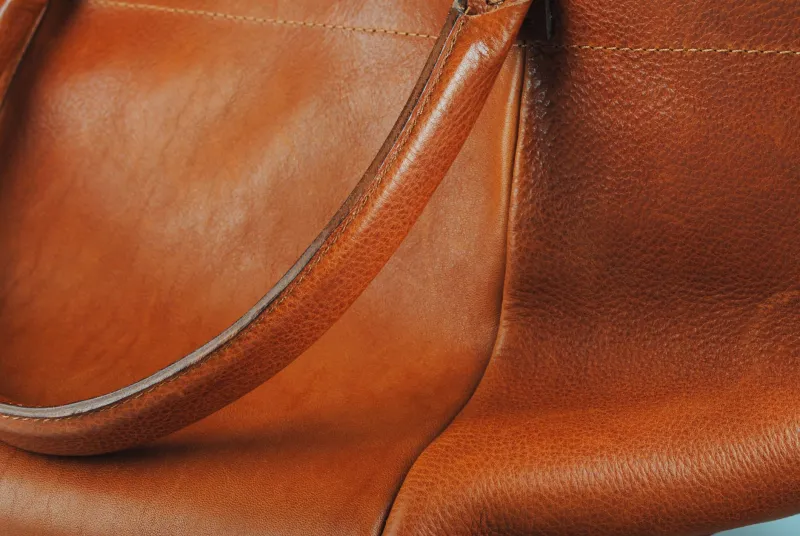
In Stage Two, the leather has conformed to the specific rhythms of its owner's use. It holds its shape without being rigid. The patina—that luminous deepening of tone produced by the natural oils of handling, exposure to light, and the slow oxidation of the tanning agents—has begun to establish itself. Corners that were once sharp have rounded to a satisfying softness. The interior has molded itself to the objects it most frequently carries.
This is, by most expert consensus, the prime of a leather piece's life. And it can last decades, provided the owner understands how to maintain it.
Patina, it bears clarifying, is not damage. It is chemistry. The oils from your hands, the ambient light of your environment, the subtle humidity of American seasons—all of these interact with the tannins in the hide to produce a surface quality that cannot be replicated by any factory process. A piece in full patina has a visual depth, an almost three-dimensional quality of surface, that a new piece simply cannot possess. It is earned, not manufactured.
Damage, by contrast, presents differently. Cracking along stress points, flaking of the surface layer, discoloration that appears blotchy rather than graduated, a loss of structural integrity in the stitching or hardware—these are not patina. They are deterioration, and they signal either neglect, improper storage, or exposure to conditions the leather was not designed to withstand.
"The distinction between character and damage is the most important thing I teach clients," notes a leather restoration specialist based in New York who works with several of the city's most prominent collectors. "Patina is additive—it enriches the piece. Damage is subtractive—it diminishes it. Once you can see the difference clearly, you start treating your leather with an entirely different level of attention."
Extending the Prime: The Practices That Preserve Stage Two
The goal of any serious leather owner is to extend Stage Two as long as possible. This requires neither obsession nor elaborate ritual—simply a set of consistent, informed habits.
Condition seasonally, not compulsively. Over-conditioning is a genuine risk. Leather fibers that are saturated with product lose their structure and can begin to break down prematurely. A light conditioning treatment two to four times per year—adjusted for climate and frequency of use—is sufficient for most full-grain pieces.
Store with intention. Leather stored in plastic, in direct sunlight, or in environments with extreme humidity or aridity ages poorly and unevenly. A breathable dust bag, a stable temperature, and occasional airing are the baseline requirements for responsible storage.
Address minor damage immediately. A small scratch buffed out within days remains a small scratch. Left for months, it can become a crack. The leather's ability to self-repair through its natural oils diminishes over time, making early intervention consistently more effective than delayed correction.
Rotate your pieces. Leather, like any material under sustained stress, benefits from rest. A bag used daily without respite ages faster than one rotated through a small collection. Even a secondary piece carried once or twice weekly provides meaningful relief.
Stage Three: Reading the Signs of Decline
Stage Three is not a failure. It is simply the natural conclusion of a material that has been genuinely used—and in many cases, genuinely loved. The signs are readable: stitching that has begun to separate at high-stress points, a surface that has lost its ability to absorb conditioner, hardware that has worn through its finish, structural elements that no longer hold their form.
At this stage, a decision presents itself. Some pieces warrant professional restoration—a process that, in skilled hands, can meaningfully extend a piece's functional life without erasing its accumulated character. Others have reached the end of their primary usefulness and are better preserved as objects of contemplation than continued daily use.
Neither outcome represents waste. A piece that has passed through all three stages of its life fully and honestly has done exactly what fine leather is designed to do. It has served. It has aged. It has told a story.
Understanding that arc—and knowing where your piece stands within it—is what separates an owner from a collector, and a collector from a custodian. The finest leather goods deserve all three.