The Leather Education: What Your First Luxury Bag Taught You That Your Next One Will Prove
There is a particular kind of clarity that arrives only after experience. In the realm of luxury leather goods, it tends to arrive while standing in front of a closet, holding a bag that cost considerably more than it should have, and recognizing — with a mixture of frustration and hard-won wisdom — exactly why it no longer feels right. The stitching has loosened at the corner. The logo hardware has tarnished. The silhouette, which felt so urgent two years ago, now reads as dated in a way that is difficult to articulate but impossible to ignore.
This moment is not a failure. It is, for most serious leather buyers, the beginning of genuine understanding.
The First Purchase: Enthusiasm Without Framework
The first foray into luxury leather is almost always driven by aspiration rather than knowledge. This is entirely natural. You have decided to invest in something real, something that will last — and that intention is admirable. But without a framework for evaluating what "lasting" actually means in material terms, the first purchase often defaults to the most visible signals of quality: brand recognition, price point, and the aesthetic approval of the moment.
The result, for a significant number of buyers, is a bag that checks the wrong boxes. It may carry a name that commands immediate recognition. It may feature prominent logo hardware or a signature pattern that communicates luxury at a glance. And for a period — perhaps a season, perhaps two — it does exactly what was hoped. It signals. It impresses. It satisfies.
Then something shifts. The logo begins to feel less like a mark of quality and more like a mark of a particular moment in time. The hardware, which once gleamed, begins to show wear in ways that reveal its plating rather than its patina. The bag begins to look like what it is: a product optimized for recognition rather than longevity.
The Second Mistake: Chasing the Correction
Armed with this new awareness, many buyers make a second, subtler error. They overcorrect. Having recognized that logo-heavy designs date quickly, they pursue the opposite — but do so reactively rather than thoughtfully. They buy the bag that is conspicuously unbranded, or the one that a trusted publication declared "the new minimalism," or the silhouette that every discerning person seems to be carrying this particular autumn.
This, too, is trend-following. It is simply trend-following with a more sophisticated vocabulary.
The correction that actually matters is not aesthetic. It is structural. The question to ask is not "what does this bag look like?" but rather "how is this bag made?"
Learning to Read Construction
The single most significant shift in a leather buyer's education is the development of an eye — and a hand — for construction quality. This is not arcane knowledge. It is observable, learnable, and once understood, impossible to unsee.
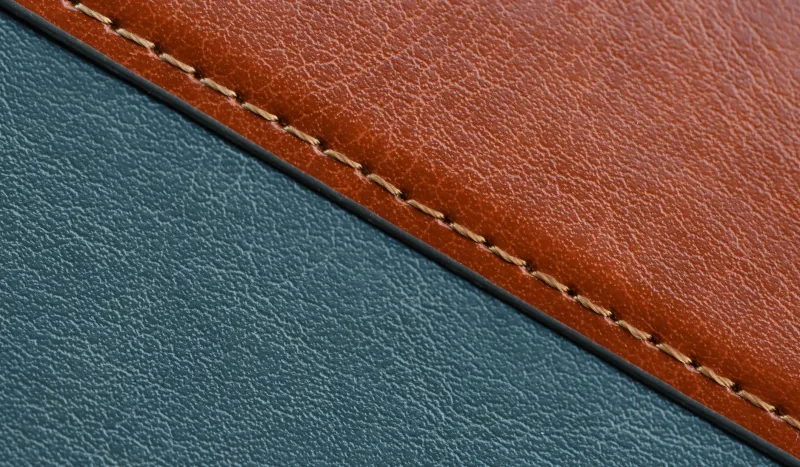
Consider the stitching. On a piece built to last, stitching is tight, consistent, and recessed slightly into the leather rather than sitting atop it. The thread is waxed or otherwise treated for durability. At stress points — handles, corners, zipper pulls — there is reinforcement. On a piece built for margin rather than longevity, stitching is often decorative in character: evenly spaced for visual effect but insufficiently anchored for real use.
Consider the hardware. Solid brass hardware, even when unpolished, maintains its integrity over years of use. It develops a character — a gentle darkening at the edges, a warmth that plated zinc simply cannot replicate. When you encounter a bag whose zipper pull already shows silver beneath its gold surface after eighteen months of use, you are looking at the evidence of a decision made at the design stage, not a manufacturing defect.
Consider the leather itself. Full-grain leather — the highest grade, in which the outermost layer of the hide is preserved intact — will absorb the oils of your hands over time, developing a patina that is genuinely unique to your use. It will not peel, crack, or delaminate, because it is not a composite. It is the real material, in its most complete form. Corrected-grain or bonded leather, by contrast, may present beautifully at the point of purchase and deteriorate in ways that full-grain never will.
The Hardware Conversation Nobody Has at the Point of Sale
One of the most undervalued considerations in luxury leather purchasing is the quality of functional hardware: the zippers, the clasps, the D-rings, the feet. These components experience more mechanical stress than any other part of a bag, and yet they are rarely the subject of discussion at the point of sale.
A zipper from a reputable manufacturer — YKK's higher-grade offerings, for instance, or the custom hardware produced by serious leather ateliers — will operate smoothly thousands of times without catching or stiffening. The teeth are machined rather than stamped. The pull moves with a satisfying weight that communicates precision.
The bag feet, those small studs on the base that protect the leather from surface contact, are similarly telling. On a well-constructed piece, they are set with screws that pass through reinforced leather, distributing pressure across a wider area. On a lesser piece, they are pressed in with a simple post — and they will eventually pull through.
None of this is visible in a product photograph. All of it is perceptible in person, once you know what you are looking for.
The Arrival: What the Informed Purchase Feels Like
When a buyer arrives at their first truly considered luxury leather purchase — the one informed by the previous rounds of experience and observation — the experience is qualitatively different. There is less excitement of the impulsive variety and more of the settled, confident kind. The bag is not the most attention-commanding object in the room. It does not need to be.
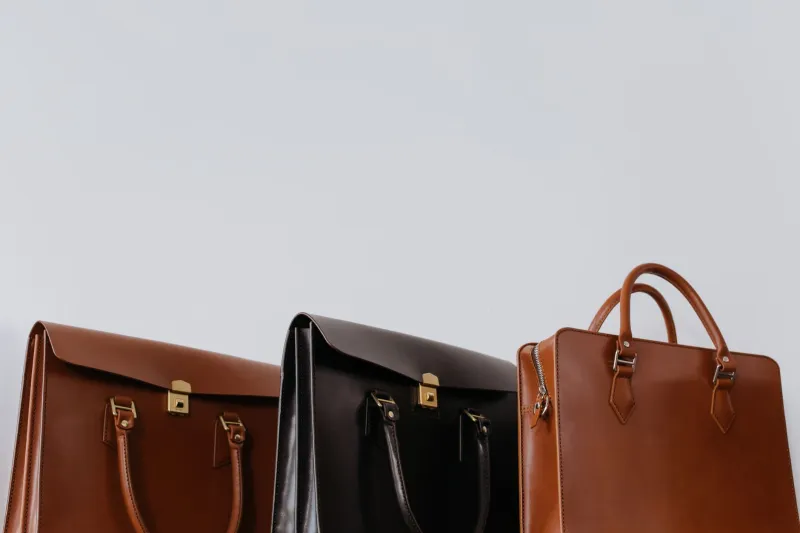
It is chosen for the quality of its full-grain leather, for the integrity of its construction at the corners and handles, for hardware that will outlast the leather itself if cared for properly. It is chosen in a color and silhouette that serves real life without being beholden to any particular season. It is, in the truest sense of the phrase, a piece built to last.
At Leather Iconic, this is the purchase we exist to support. Not the first one — which teaches. Not the second one — which corrects. But the one that reflects everything those earlier choices made clear.
The leather education is rarely short. But the piece it leads you toward is worth every lesson.