The Confidence of Restraint: How the Unbranded Leather Bag Became America's Most Powerful Accessory
The Confidence of Restraint: How the Unbranded Leather Bag Became America's Most Powerful Accessory
For decades, the visible logo functioned as the dominant grammar of luxury in America. A monogrammed canvas tote or a hardware-heavy handbag communicated membership in a particular tier of consumer society — loudly, immediately, and without ambiguity. Status was worn on the surface, legible from across a room. That grammar, it turns out, had a shelf life.
Something has shifted in the way Americans signal sophistication. The change is not uniform, and it has not happened overnight, but its direction is unmistakable: the most style-conscious consumers in the country are increasingly reaching for pieces that carry no external declaration of their worth. The logo-free leather bag — impeccably constructed, quietly confident, and entirely free of the need for external validation — has emerged as the defining accessory of this cultural moment.
From Celebrity Wardrobes to Conference Rooms
The term "quiet luxury" entered mainstream vocabulary through the wardrobes of a particular kind of public figure: the old-money heir, the understated executive, the individual so secure in their position that the idea of advertising a brand name struck them as faintly gauche. It was observed in the neutral palettes and unadorned leather goods favored by figures in finance, law, and the upper echelons of American business culture — people for whom the point was never to be seen trying.
What began as the aesthetic province of a narrow demographic has since traveled considerably further. The sensibility has filtered into mainstream American professional life, driven in part by a broader cultural fatigue with conspicuous consumption and in part by a generation of consumers who came of age watching fast fashion collapse under the weight of its own disposability. The question being asked with increasing frequency is not "What brand is that?" but rather "Who made that, and how?"
This is a meaningful distinction. It signals a shift from consumption as performance to consumption as conviction — from wearing a logo to demonstrate purchasing power to choosing a piece that demonstrates actual discernment.
Why Silence Speaks Louder
There is a particular kind of confidence required to carry an accessory that offers no brand name as social shorthand. The piece must justify itself entirely through what it is — the quality of the leather, the precision of the construction, the way it holds its shape after years of use. There is no borrowed prestige available, no familiar monogram doing the work of communication on the owner's behalf.
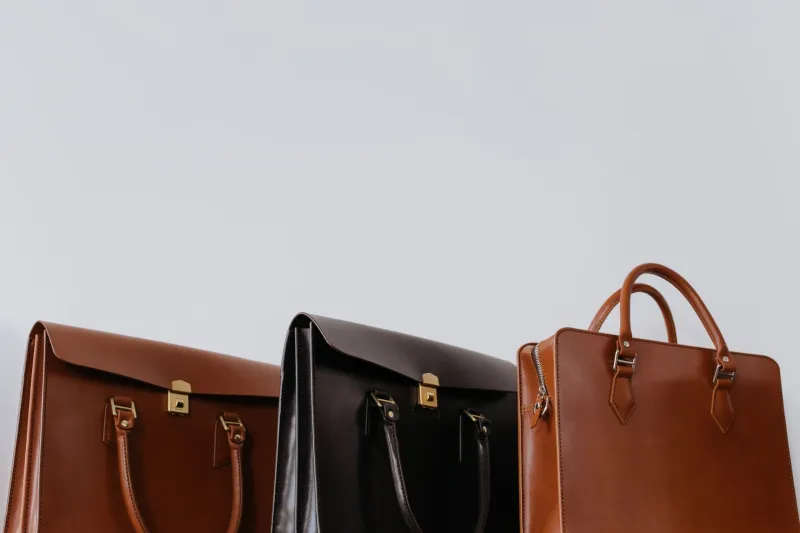
This is, paradoxically, a far more demanding standard than the logo-heavy alternative. A well-known luxury logo can obscure mediocre construction beneath the weight of its cultural cachet. A logo-free leather bag has nowhere to hide. Every stitch, every edge finish, every choice of hardware is visible and subject to scrutiny by anyone who knows what to look for.
And increasingly, Americans do know what to look for. The proliferation of craft-focused media, the growth of communities dedicated to leather goods and heritage manufacturing, and a general elevation of material literacy among younger professional consumers have created an audience capable of reading quality without a brand name to guide them. For this audience, the absence of a logo is not a deficit — it is a declaration.
It says: the piece is enough. And so, by extension, is the person carrying it.
American Values, Quietly Expressed
There is something distinctly American about the quiet luxury sensibility, even if the term itself arrived through the observation of European old-money aesthetics. The American cultural tradition — at its most principled — has always held a certain suspicion of empty spectacle. Substance over show. Work over talk. Results over reputation.
These are, of course, ideals rather than universal realities, but they represent a genuine strand of American self-conception. The craftsman who builds something to last, the professional who lets their work speak for itself, the individual who dresses with care but without performance — these are recognizable archetypes in the American cultural imagination.
The unbranded leather bag fits this tradition precisely. It is the accessory equivalent of a firm handshake: direct, assured, and entirely without pretense. It does not ask for admiration. It simply merits it.
How to Identify True Quality Without a Logo as a Guide
For those navigating the logo-free leather market for the first time, the absence of familiar brand signals can feel disorienting. The following considerations provide a reliable framework for distinguishing genuine quality from its imitations.
Examine the leather itself. Full-grain leather — the highest grade, with its natural surface intact — will have subtle tonal variation and visible pore structure. It will feel substantial without being stiff, and it will develop character with use. Avoid anything described vaguely as "genuine leather" or "vegan leather" if longevity is your objective; these terms frequently describe materials with limited durability.
Inspect the stitching. On a quality piece, stitching is even, tight, and consistent. Thread ends are properly finished rather than left loose. Stress points — handles, corners, zipper attachments — are reinforced. Uneven or skipped stitches are an immediate disqualifier regardless of price point.
Assess the hardware. Zippers, clasps, and rings on a well-made leather bag are weighty and smooth in operation. They do not catch, squeak, or feel hollow. Brass and solid steel are preferable to plated zinc alloys, which corrode and degrade with use.
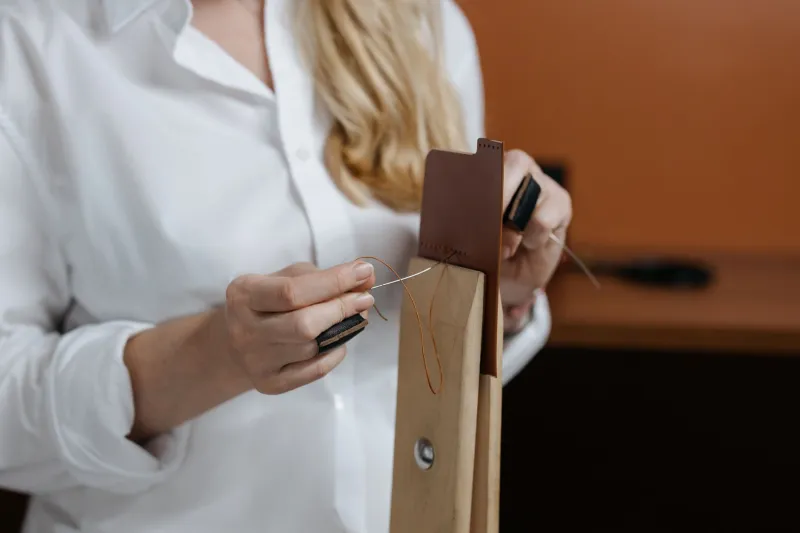
Consider the construction method. Hand-stitched and saddle-stitched leather goods — where two needles work simultaneously through pre-punched holes — are significantly more durable than machine-stitched alternatives. If one thread breaks in a saddle-stitched piece, the rest holds. In a machine-stitched piece, a single break can cause a seam to unravel entirely.
Research the maker. Brands willing to be transparent about their leather sourcing, tanning methods, and manufacturing processes are brands with genuine quality to defend. Opacity about process is rarely a good sign.
The Accessory That Needs No Introduction
The logo-free leather bag does not introduce itself. It does not need to. Over the course of a meeting, a dinner, a season, a career, it simply demonstrates — through its continued excellence, its graceful aging, its quiet refusal to deteriorate — that the person who chose it understood something that others are only now beginning to appreciate.
At Leather Iconic, this is precisely the standard we hold ourselves to: pieces that communicate through craft rather than branding, that earn their status through what they are rather than what they display. The most iconic accessories have never required a label to be recognized. They are, in themselves, the statement.
In an era of noise, restraint has become the most sophisticated form of expression available. The logo-free leather bag is not a rejection of luxury. It is its purest form.