Reading the Object: A Field Guide to Recognizing Genuine Leather Craftsmanship
Prestige marketing is extraordinarily good at one thing: making the label do the work that the object should do itself. Consumers are taught, through decades of aspirational advertising, to associate a name—a monogram, a heritage story, a celebrity endorsement—with quality. The assumption is that the brand has already done the evaluation on your behalf.
This is a comfortable arrangement for the industry. It is a less comfortable one for the buyer who eventually discovers that the name on the bag and the quality inside it are not always the same conversation.
The most sophisticated leather buyers in America have moved beyond this dependency. They evaluate the object directly—examining material, construction, and design integrity on their own terms, independent of what the label says or what the marketing suggests. This skill is learnable. It requires attention, not expertise, and it will serve you regardless of whether you are purchasing from a century-old American saddler, a European heritage house, or an emerging independent maker whose work has not yet found its audience.
Start With the Hide Itself
Leather quality begins before any craftsman touches it. The hide grade determines nearly everything that follows—how the material will age, how it will respond to use, and whether it will develop the patina that defines a truly enduring piece or simply deteriorate.
Full-grain leather is the highest grade available. It retains the complete outer surface of the hide, including the natural grain pattern, which means it is denser, more durable, and more expressive than corrected alternatives. Run your hand across the surface of a full-grain piece and you will feel slight variation—minor imperfections, natural markings, the character of an actual animal hide. This variation is not a flaw. It is evidence.
Top-grain leather has been sanded to remove surface blemishes and then embossed with an artificial grain pattern. It presents more uniformly than full-grain, which appeals to consumers conditioned to expect visual perfection—but that uniformity comes at the cost of the hide's natural fiber structure, reducing durability and limiting the depth of patina development over time.
Bonded leather, at the lowest tier, is essentially a composite material: leather scraps and fibers bonded with polyurethane onto a fabric backing. It looks like leather in the store. It will not look like leather in eighteen months.
The practical test: press your thumb firmly into the surface and release. Full-grain leather will show a slight impression that fades slowly. Bonded or heavily corrected leather will spring back immediately, or, in the case of older bonded material, show stress cracks around the pressure point.
The Stitching Tells the Truth
If the hide is the soul of a leather piece, the stitching is its conscience. No element of construction reveals the maker's standards more clearly or more honestly.
Saddle stitching—the traditional hand-stitching method in which two needles work simultaneously from opposite sides of the leather—is the benchmark of serious craftsmanship. It produces a stitch that is mechanically superior to machine stitching: if one thread breaks, the rest of the seam holds. Examine the stitch line closely. Saddle stitching is typically slightly raised, with consistent tension and a slight diagonal orientation to each stitch. The spacing will be even but not mechanically perfect—the slight variation of handwork is itself a quality signal.
Machine stitching is not inherently inferior, but it requires examination. Look for consistency in stitch length and tension across the entire seam. Loose threads, skipped stitches, or thread that appears to sit on top of the surface rather than pulling through the leather are indicators of rushed or careless production. Check the corners and stress points particularly—these are where construction shortcuts reveal themselves first.
Thread material matters as well. Linen and waxed polyester threads are the appropriate choices for quality leather goods; they resist abrasion and do not absorb moisture in ways that accelerate degradation. Thin, cheap thread on a heavy leather piece is a warning sign worth heeding.
Hardware as Honest Testimony
Zippers, clasps, rings, and buckles are the hardware of a leather piece, and they are among the most honest reporters of overall quality standards. A maker who invests in excellent hide and careful construction will not undercut that investment with inferior hardware—and a maker cutting costs will often do so here, where the savings are significant and the compromise is not immediately obvious to the casual buyer.
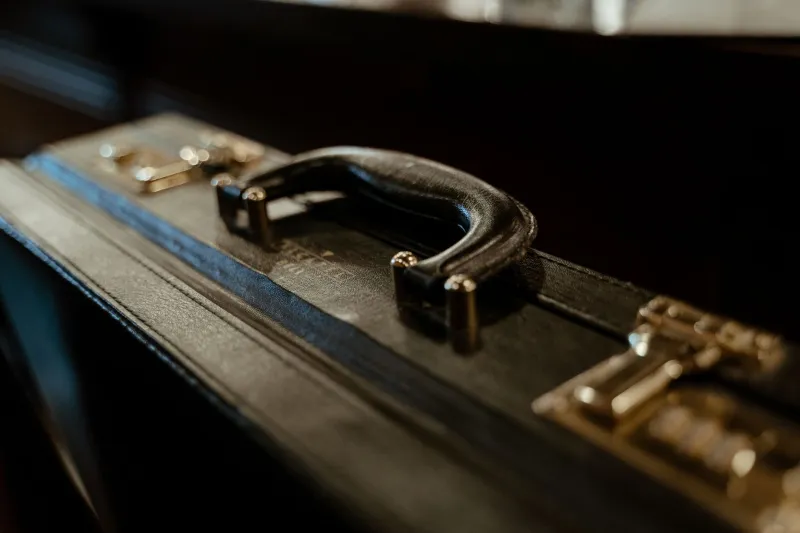
Brass hardware—solid, not plated—carries weight in the hand and develops a warm patina that complements aged leather. Steel hardware is appropriate for more utilitarian pieces and holds its finish reliably. Both are preferable to zinc alloy hardware, which is lighter, prone to tarnishing, and susceptible to structural failure under regular stress.
Test any zipper before purchasing. A quality zipper—YKK's premium lines or comparable European alternatives—glides without resistance and closes completely without manipulation. A zipper that requires coaxing in the store will require replacement within a year.
Examine how hardware is attached. Rivets should be solid, flush, and symmetrical. Screws, where used, should be recessed and tight. Any hardware that moves when it should be stationary is a construction failure, not a quirk.
The Interior as Character Witness
Amateur buyers examine the exterior. Experienced buyers examine the interior.
The lining of a leather bag is a direct reflection of the maker's commitment to completeness. Quality linings are typically suede, leather, or tightly woven textile—materials chosen for durability and tactile appropriateness, not cost minimization. Examine the seams where the lining meets the leather shell. They should be clean, even, and finished. Unraveling edges, visible glue residue, or lining that has already begun to separate from the shell in a new piece are reliable indicators of the attention given to the entire object.
Pockets and interior structures should be functional and proportional—designed by someone who has considered how the bag will actually be used, not simply how it will photograph. Interior hardware, like exterior hardware, should operate smoothly and feel substantial.
The Question of Smell
This is a checkpoint that surprises some buyers, but it is among the most reliable. Quality full-grain and vegetable-tanned leather has a distinctive, pleasant smell—earthy, slightly woody, complex. This is the natural result of the tanning process and the hide's own character. It deepens rather than fades as the piece ages.
Bonded leather and heavily synthetic materials often smell of chemicals—adhesives, polyurethane coatings, or the solvents used in their production. This odor may dissipate partially over time, but it signals the material composition more honestly than any marketing copy.
Trusting the Object Over the Narrative
The practical application of these checkpoints is straightforward: handle the piece before you purchase it. Examine the stitching under good light. Press the hardware. Open and close every zipper and clasp. Look inside. Smell the leather.
None of this requires specialized knowledge. It requires only the willingness to evaluate the object on its own terms—to let the craftsmanship speak rather than the label. When those two voices align, you have found something worth owning. When they diverge, the object has told you something the marketing never would.