The Appointed Desk: How Leather Is Redefining the American Workspace
There is a particular kind of professional who understands that the environment in which work is done shapes the quality of the work itself. They are not decorators in the conventional sense. They are curators — people who recognize that every object within arm's reach either earns its place or diminishes the whole. For this cohort, the wardrobe has long been a studied exercise in intentionality. Now, that same discipline is moving inward, past the front door, past the closet, and settling squarely on the surface of the desk.
Leather, the material that has defined American ambition from the saddleries of the frontier West to the corner offices of Manhattan, is finding its most intimate expression yet: the workspace. Not as a trophy piece or an affectation, but as a functional philosophy — a way of organizing the mind by first organizing the surface upon which it operates.
Why the Desk Is the New Wardrobe
For decades, the conversation around personal style in professional America centered almost exclusively on what one wore. The briefcase was an extension of the suit. The wallet was the punctuation mark at the end of a carefully composed sentence. But as the home office has become a permanent fixture in American life — accelerated by cultural shifts that show no sign of reversing — the desk itself has emerged as a primary site of self-expression.
Consider what a desk communicates. It is where decisions are made, correspondence is drafted, and ideas are given their first physical form. It is, in many respects, the most honest portrait of a person's working mind. A cluttered surface suggests a scattered one. A desk appointed with intention — with objects chosen for their quality, their utility, and their beauty — suggests something else entirely: a person who holds their attention as a resource worth protecting.
Leather, with its inherent qualities of durability, texture, and earned character, is uniquely suited to this role. It does not shout. It settles. And over time, it only grows more expressive.
The Foundational Pieces of a Leather Desk
For those beginning to think about the workspace as an extension of their personal standard, certain pieces serve as natural starting points.
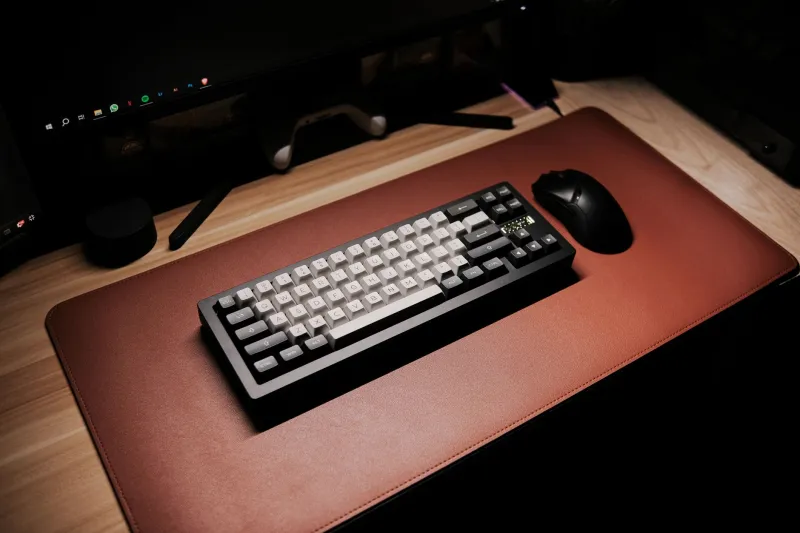
The Desk Pad. Few objects transform a work surface more immediately than a full-grain leather desk pad. Where a bare desk is merely functional, a leather pad creates a defined zone — a stage, in a sense, upon which the day's work is performed. The tactile experience of resting one's wrists on supple leather rather than cold wood or synthetic material is not trivial. It is the kind of small, daily luxury that accumulates into something meaningful over months and years. Quality examples, cut from vegetable-tanned hides and finished by hand, develop a patina that no synthetic material can replicate.
The Catchall and Tray. Every desk, no matter how disciplined its owner, accumulates the small artifacts of daily life — keys set down between meetings, a watch removed before a call, a coin left from yesterday's lunch. A leather catchall imposes order on this inevitability with quiet authority. Unlike ceramic or plastic alternatives, a leather tray carries a warmth that makes the act of organization feel deliberate rather than merely tidy.
The Pen Case. In an era when most written communication travels digitally, the person who maintains a considered collection of fine writing instruments makes a statement about the value they assign to the physical act of writing. A leather pen case — structured, lined, and built to last a generation — honors that commitment. It is a small object that carries considerable philosophical weight.
The Cable and Tech Organizer. Perhaps the most modern entry in the leather desk canon, the cable organizer represents the material's willingness to evolve without abandoning its principles. The finest versions wrap the necessary infrastructure of contemporary work — charging cables, earbuds, adapters — in the same full-grain leather used for far more storied applications. The result is a desk that acknowledges the digital present without surrendering to its tendency toward disorder.
The Notebook Cover. Even those who conduct the majority of their work on screens will often maintain a physical notebook for the thinking that precedes the typing — the rough sketches, the half-formed ideas, the lists that organize the day before it begins. A leather notebook cover elevates this practice from habit to ritual.
Craft as Commitment
What unites these objects is not merely their material but the values they embody. To choose leather for the desk is to choose craft over convenience, longevity over disposability, and presence over distraction. These are not small choices. In a culture that rewards speed and rewards novelty, the deliberate selection of objects built to outlast a single season — or a single decade — is itself a form of resistance.
The finest leather desk accessories available to the American consumer today are made by artisans who apply the same techniques used for briefcases and belts. Edges are burnished by hand. Stitching is executed with thread chosen for its tensile strength as much as its aesthetic contribution. Hardware, where it appears, is solid rather than plated. These are not objects manufactured to a price point. They are objects manufactured to a standard.
That standard matters because it is felt — not always consciously, but persistently. Sitting down to work at a desk appointed with quality leather creates a subtle psychological shift. The environment signals seriousness. It signals that the person who inhabits this space has considered what they are doing and why. That signal, directed inward, has a measurable effect on focus and output.
The Desk as Personal Philosophy Made Visible
There is a reason that the offices of America's most accomplished individuals — the architects, the attorneys, the founders, the editors — have long featured leather in prominent roles. It is not mere decoration. It is alignment. The objects that surround a person during their most focused hours should reflect the same values they bring to their most important work: precision, durability, and an understanding that quality is not an extravagance but an investment.
The leather desk does not announce itself. It does not require explanation or justification. It simply exists, doing its work quietly and completely, improving with every passing year. Much like the person who chose it.
For those who have already extended their commitment to craft into their wardrobe, the workspace is the natural next frontier. The desk, after all, is where the most consequential version of yourself shows up every morning. It deserves to be dressed accordingly.